

If you are new to the SEO world, especially in the last few years, as AI has become an ever-present piece of the conversation, you’ve probably heard a lot about site architecture.
Because site architecture is such a backbone piece of SEO, it might seem a bit daunting, but it doesn’t have to be. As long as you understand what it is and how you can influence it through various techniques, it can be a massive help in allowing your site to succeed in its vertical.
What is Site Structure and Site Architecture?
First, let’s define site architecture. Site architecture is basically the interconnectivity between related pages across a website to establish a hierarchical structure and build relationships. When looking at EEAT (experience, expertise, authority, and trust), site architecture helps build upon the authority and trust signals.
In SEO, it is common to conduct keyword research to understand how users search for content you are creating and ranking on your site. By grouping these terms you are researching into broad buckets of related terms, you are essentially performing an information architecture (IA) exercise that can inform topic silos to help you build out content, connect them, and build trust and authority for that topic. By doing so, your site then has a greater opportunity to rank within your vertical.
I like to use the metaphor of a website being a house. If you think of a website this way, the pages of the site represent the rooms that you live in, while the hallways are the various ways you connect the pages. If a room doesn’t have a hallway, it is less likely to be found easily. And once it is found, a user or crawler would have less ability to get to other pages of the site because it has no interconnectivity. It would be like having to get to your bedroom by going in and out of a window.
Types of Site Structures
The type of website you have will help inform the site architecture you use. If I were to visit a large e-commerce site to buy a pair of hiking shoes, I wouldn’t expect the site to navigate like a local contractor’s website. Some areas, like a blog, might have a similar structural breakdown, but the commercial area of the site utilizes an entirely different approach.
Hierarchical/Tree Structure
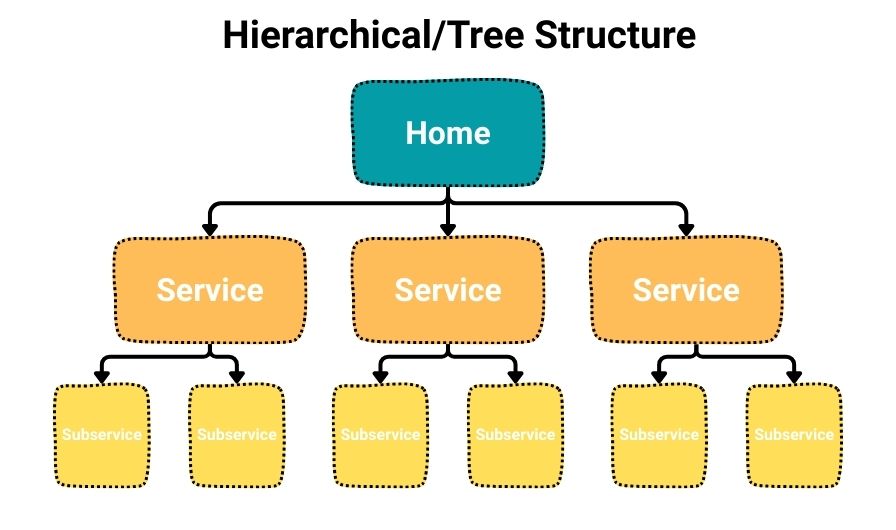
This is one of the most common site structures you will encounter on a website. This starts at the homepage, then breaks out into the various services/categories across the site, and then into the supporting content for those services/categories.
In this model, you move top-down and establish parent-child relationships between pages to help users navigate the site and find what they are looking for.
This is a prevalent approach for websites that represent businesses with key services and products. The homepage represents the top-level of the structure, with each service/offering/product as the next level down.
Flat Structure

While not ideal for most websites, a flat structure is ubiquitous for smaller sites.
This means that pages appear right after the site’s homepage in the structure and do not go any deeper. Usually, these sites contain 50-100 pages at the most, at least the ones that use this structure and perform well in SERPs. But for scalability, I try to avoid this approach unless it is for a site that only needs a handful of pages and a small blog for content additions.
Hub and Spoke Structure
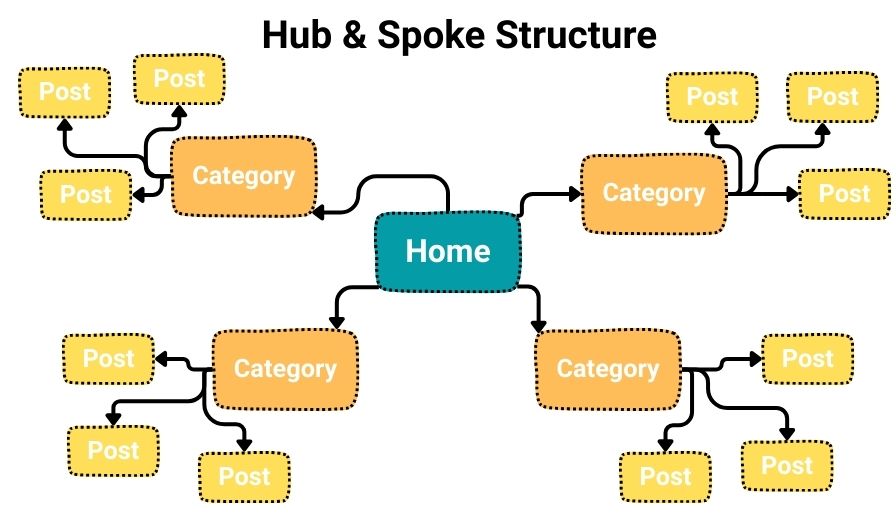
Slightly similar to a hierarchical/tree structure, a hub-and-spoke model establishes top-level categories that branch into subcategories. The most significant difference here is that they are not necessarily dependent on a top-level parent page. These categories can live on their own as an almost individual experience.
It’s common to see this approach on a website’s blog, where category pages can be the main entry point for users to navigate into deeper-level content.
Unless the site itself is a standalone blog, it’s common to see this model used alongside a hierarchical structure. One is used for commercial content, while the other is used for informational content, with internal links connecting the two when appropriate.
Sequential Structure
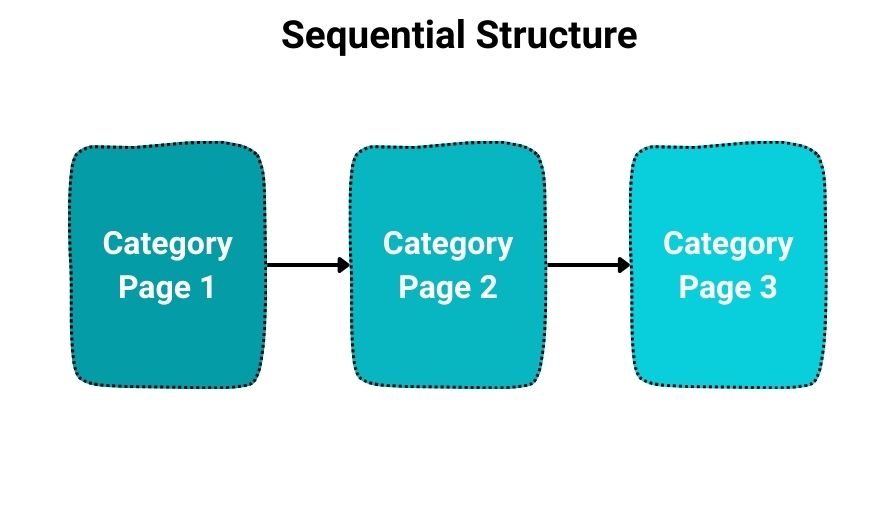
Often referred to as pagination, this type of structure establishes pages from a starting point and moves to the next page in sequence. This is a very common approach when working with a site that offers classes and training materials to get users from the first lesson to the very end.
I like to think of this as a “building block” approach to site structure. The types of content best suited to this structure build on each other in easy-to-digest bits.
This is also a great way to build authority for a specific topic, such as in a blog. When crawlers find a blog category page and see that you have several pages worth of content within that category, it gives the site more authority signals for the topic. The key is ensuring these paginated pages use unique on-page signals and a URL structure that allows search engines to crawl and index them.
How to Organize Site Architecture
Now that we know what site architecture is, how do we establish it across a website?
Before we get into the details of the signals that influence site architecture, I recommend having your research in place before making any decisions on your approach, especially if you’re working on a new website build. Getting these things done correctly from the start will lay a much stronger foundation for organic search success.
It is essential to keep in mind that, for the following items, no single piece should be the sole focus of your site structure initiatives. It’s when all of them are combined that a successful site structure can be appropriately established.
URL Folder Structure
The number one way to establish a specific website structure is through the site’s URL paths. Essentially, each new path, or subdirectory, of a URL is another folder within the website’s server directory. When a subdirectory comes after another, that means it is nested within that previous subdirectory. This is one of the most common ways to establish site architecture.
Now, it’s essential not to get too carried away with this approach, as it can have negative implications if it becomes too complicated, which we will touch on later. The critical thing to do is get all your information architecture research in place so you can start making decisions about which subdirectories you will need based on how you are structuring your site. Figure out where the services you are offering will live and where you will house informational content.
My main word of caution is that once you have a URL structure in place, try your best not to change it. We will talk more about equity distribution in a bit, but understand that URL changes require redirects, which can take time for crawlers to understand fully. It is rarely worth the risk to migrate and change URLs, especially on an already established website with a ton of history and link equity.
Example URL Structure: https://www.domain.com/folder-1/folder-2/
Breadcrumbs
The best way to describe breadcrumbs is to think of them the same way as they are used in the fairy tale Hansel and Gretel. As the two characters drop breadcrumbs along the way of their journey to help them find their way back home, website breadcrumbs do the same thing. They serve as a secondary level of navigation to help users get back to the previous section of the site. But they do a lot more than that when it comes to technical SEO and site structure.
Let’s say you are working with an established website, but you find opportunities to connect its content better. Because the site already has history and backlinks, you don’t want to update your URLs even for the sake of improving site structure. It would just cause too many variables that could cause performance issues. This is where breadcrumbs come in. You can take that research you have put together to create a breadcrumb path on the page that establishes the relationship to the appropriate pages before it in the path, usually a category page. Something to develop the topic silo.
With this methodology, you can do the same thing as changing the URL structure without all the hassle and risk. When doing this, it is best to include the breadcrumb structured data markup on the page using either inline schema or JSON-LD. JSON-LD is the preferred method because it is more efficient and easier for crawlers to read. By doing so, you not only easily establish this page relationship for both users and crawlers, but also increase the opportunity to influence how your page appears in SERPs with additional features.
One additional consideration is how categories are attached to a page, as in a blog. It’s not uncommon for a post to be attributed to multiple categories. In this case, it’s essential to work with a trusted developer to ensure the blog’s main category is displayed in the breadcrumb structure to achieve the most significant impact. The pagination on the additional categories should help establish it as an authority within the other categories it is attached to. So make sure to take the time to determine where the post makes the most sense categorically and where it will have the most impact.
Example Breadcrumb: Blog | Category | Sub-Category | Post Title
Internal Linking
As SEOs, we understand the importance of link building and how these signals establish our site as an authority in the vertical in which we create content. But one thing that might be overlooked in the link building consideration is how those links can benefit the rest of the website. That’s where internal linking comes into play.
Think of internal linking as a champagne tower where the equity from the links you build is the champagne pouring into the main glass. Without the glasses underneath the main glass, there will be nowhere for the champagne to go, so it stays in one place. Using this way of thinking, by linking to logical and related pages, you are creating the ability to flow equity between pages. This then allows your entire site, when done well and methodically, to benefit from your marketing initiatives. This is one of the main ways you can improve the authority of your pages within their topic silos.
Why Does Site Structure Matter for SEO?
Crawlability and Indexation
Being found is at the heart of what we do as SEOs. The ultimate goal of our work is to provide search engines with an environment that makes it easy for them to understand and rank our sites appropriately, driving traffic to our target audience. Like the rooms-and-hallways metaphor I mentioned previously, interconnectivity is crucial for crawlers to find a site.
By connecting pages through the methods mentioned above, a site improves its ability to be discovered by crawlers and to go deeper on your site, seeing the rest of your pages and understanding their relationships. Because this was so easy for them, they will come back and crawl your site more often, which creates a healthier indexation rate.
This is particularly useful when updating a page. If crawlers can’t find the page, they’re less likely to see your content promptly, ingest and understand the updates you made, and do so without manually influencing the crawl through tools like Google Search Console. Thus, it will take even longer to see rank improvements.
Now, when looking at the crawlability of a website, especially a really large one with millions and millions of pages, it is unrealistic to expect crawlers to reach those pages frequently, since that crawling consumes their resources and budgets. That’s why it is crucial to ensure that anything you want ranking on a site and seen more often is appropriately connected, while other parts that aren’t meant to be found in search are less connected. This is usually referred to as “crawl waste” when considering crawl budget.
Another consideration is orphan pages. These are pages with no links pointing to them on the site, so they are not easily findable and do not receive or pass SEO equity. It’s very important to ensure your site doesn’t have a page floating off into the void, providing zero value. If you find these, make sure to assess whether this page is valuable, and decide whether it should be deleted (and possibly redirected) or whether links should be built to and from it.
Link Equity Distribution
Because this is such a crucial part of creating a favorable site structure, we have already discussed this previously. But it’s worth noting a few additional points about the importance of internal links to SEO.
Yes, it is essential to link related pages to help flow link equity (also known as PageRank) and other authoritative signals between pages in a topic silo. Still, it is also important to do this methodically. One thing to be mindful of is the possibility of diluting the page’s potential for equity flow too much. It’s as if the glass in my previous metaphor also had a bunch of holes in it. The champagne would flow everywhere, and less would end up in the desired glass below. The same is true with internal links. So proceed with caution and make sure your linking strategy is logical and makes sense for the user’s journey.
User Experience Signals
I mentioned that one of the benefits of breadcrumbs is that they act as a secondary layer of navigation for users. Much like breadcrumbs, internal links act the same way. By giving users more opportunities to navigate to additional pages on your site, you increase their time on your site while subconsciously establishing your brand as an authority, which could then impact their future purchase decisions.
Similarly, crawlers notice and understand this. If search engines see that your site is being visited and navigated deeper by users coming from organic search, they will assume your site is more trustworthy. You are clearly delivering an experience favorable to your audience, which is one of many considerations in the ranking process. So keep that in mind when building out your site architecture.
Keyword Targeting and Topical Authority
One of the most significant SEO benefits of having a well-thought-out site structure is the ability to cluster content into semantically relevant groupings. This approach is what helps create a fully realized topic silo that establishes trust and authority.
It’s key to take a topic and examine all the opportunities to address additional, semantically relevant questions within that topic silo, so that anything the user could be looking for is covered on your site. This will help keep the user engaged with your content and encourage them to come back when needed, even to purchase in the future. It builds confidence in your audience that you know what you are talking about and can help them solve the problems they face.
One thing to be mindful of when creating topic silos is the tendency to cannibalize content, especially between informational and commercial intent content. It’s very easy for a service or product page to target the same keyword, which can confuse crawlers as they try to rank your pages in SERPs. Take the time to really understand how searchers perform search queries at every stage of the buyer’s journey, so you can differentiate your page types to meet those intents appropriately.
Why Does Site Structure Matter for SEO?
As the goals and KPIs of SEO work continue to evolve to include AI search, it is increasingly important to ensure your website has a site architecture that makes it easier for LLM crawlers to find.
Topical authority is a significant factor in whether a source is cited in generative AI results. Because LLMs use a combination of traditional SERPs and an understanding of your brand to piece together answers to user questions, having a site structure that boosts trust and authority signals plays a huge role in that decision-making process. Not only will it help strengthen your brand understanding with the LLMs, but it will also give them a roadmap to understand your content better and use it in other relevant answers.
While LLMs don’t necessarily crawl a website in full when generating an answer, having relevant internal links, breadcrumbs, and logical URL paths helps them find additional content when it’s available. Topic silos help address query fan-out by anticipating users’ future questions and adding semantically relevant information for each topic.
Organize for Success
At the end of the day, well-executed SEO initiatives are what give a site a leg-up in both traditional SERPs and AI search results. Site architecture is a foundational piece of that puzzle. The goal is to build trust and authority not only with your audience but also with search engines and AI systems to get your site in front of as many relevant eyes as possible, who might be making purchasing decisions your brand needs to be part of.